
Paradise Directory Collections
There is no verified, uninterrupted Paradise municipal directory series. The documented trail is largely filed under Las Vegas or Clark County, so a Paradise researcher needs to use postal-city, street, and subdivision variants. The Library District confirms city and telephone directories in its Las Vegas history collection, while UNLV finding aids identify distinct boxes and microforms. The table separates documented holdings from a claim of complete annual coverage, which the research did not establish.
| Collection | Years | Where Held | Access |
|---|---|---|---|
| Nevada Territory U.S. city directories | 1861-1882 | UNLV Microforms, four reels | Research-room finding aid |
| Paradise Valley holdings | 1950-1965 | UNLV Regional History Files, box 18 | In-person finding-aid request |
| Luskey Las Vegas Criss-Cross | 1956, 1957, 1959, 1966, 1967 | Nevada State Museum Las Vegas | Reverse-address research, verify on shelf |
| Las Vegas City Directory | 1969 | UNLV Regional History Files, box 12 | In-person request |
| Mullin-Kille supplement sample | 1975 sample page | UNLV scanned oral-history PDF | Online sample, business entries only |
The Library District collection remains important for nearby years, but its public genealogy page does not publish a full shelf run. Ask local-history staff for the exact volume, telephone book, newspaper index, or database that fits the date. A missing year in the table is a reason to ask, not proof that a volume never existed.
Note: Paradise records are often cataloged under Las Vegas or Clark County, so test each place-name and street variant before concluding that a directory lacks an entry.
Paradise Holdings Filed Under Las Vegas
Paradise is legally unincorporated, while Las Vegas commonly appears as the postal city. That geography explains why local historical directories may be Las Vegas volumes rather than books titled Paradise. UNLV's Regional History Files identify Paradise Valley material for 1950 through 1965 in box 18 and a Las Vegas City Directory for 1969 in box 12. Those are useful, specific leads, not evidence of an annual run. Search the finding aid by both community names and request adjacent materials from staff.
UNLV Microforms lists United States city directories that include Nevada Territory directories for 1861 through 1882 on four reels. Their entries may include names, residences, heads of families, firms, officers, streets, churches, schools, and associations. The collection is a research-room resource rather than a free Paradise name index, so plan to use the finding aid and request the relevant reel.
For later local context, the Las Vegas-Clark County Library District genealogy resources provide card-access databases and local-history leads. Its published resources include city directories, local histories, census material, newspapers, and obituaries, but access can depend on a library card or visiting a library building.
Paradise Reverse Directory Evidence
A reverse, or criss-cross, directory begins with an address rather than a surname. It is the clearest historical route when a researcher knows a Paradise street and number but not the household name. The strongest exact local evidence is Luskey's Las Vegas Criss-Cross City Directory at Nevada State Museum Las Vegas for 1956, 1957, 1959, 1966, and 1967. Search the address section first, copy the name exactly as printed, then check the alphabetical section for a matching entry.
- Criss-cross directory
- An address-ordered section that helps move from a street and number to the entry printed for that address.
- Householder index
- An alphabetical arrangement headed by a household name when a particular volume includes one. Check the volume's structure instead of assuming it is present.
- Abbreviation key
- The volume's printed legend for street, name, and status abbreviations. Read or photograph it before interpreting any mark.
Spelling variants matter. Las Vegas-area indexes can use initials, shortened names, married or widowed notations, and abbreviated streets. Normalize suffixes such as avenue or boulevard, but retain the wording from the original entry in research notes. An absence from an address section can reflect coverage, postal labeling, or index design. It does not establish vacancy.
Reading a Paradise Directory Entry
The local sample that was directly inspected is a 1975 Mullin-Kille Las Vegas Nevada ConSurvey City Directory Supplement, not a residential alphabetical listing. It shows why the kind of volume must be identified before its entries are used. On page 65, the visible records are business entries. They supply an entry name, street address, and telephone number, but do not establish an occupant, spouse, occupation, or ownership status for a home.
| Entry name | The printed business or organization name in the 1975 supplement. |
|---|---|
| Street address | The street address printed for that entry, useful for place and street-history research. |
| Telephone number | The number printed with the entry, if present. |
| Volume type | A Mullin-Kille supplement sample, not proof of a residential household listing. |
| Interpretation limit | Confirm people, occupancy, and dates with a relevant directory, census, newspaper, or official record. |
The UNLV directory supplement scan is a helpful visual example of the fields that can appear on a page. It should not be read as a census of Paradise residents or as a substitute for the separately held directory volumes.
Paradise Directory Streets on Maps
Old directory addresses need a map bridge before they are matched to a modern parcel. UNLV's R.L. Polk & Co. Official Arrow city map of Las Vegas and vicinity, dated about 1957 through 1961, includes a street index and insets. The wider UNLV map catalog also has local editions dated from 1952 through 1979. Use a map to compare a historical street reference with a subdivision or later assessor description, then confirm the connection through a plat book and page or legal description.
UNLV's digitized Las Vegas map collection offers a useful visual route between a Paradise directory address and its period street geography.
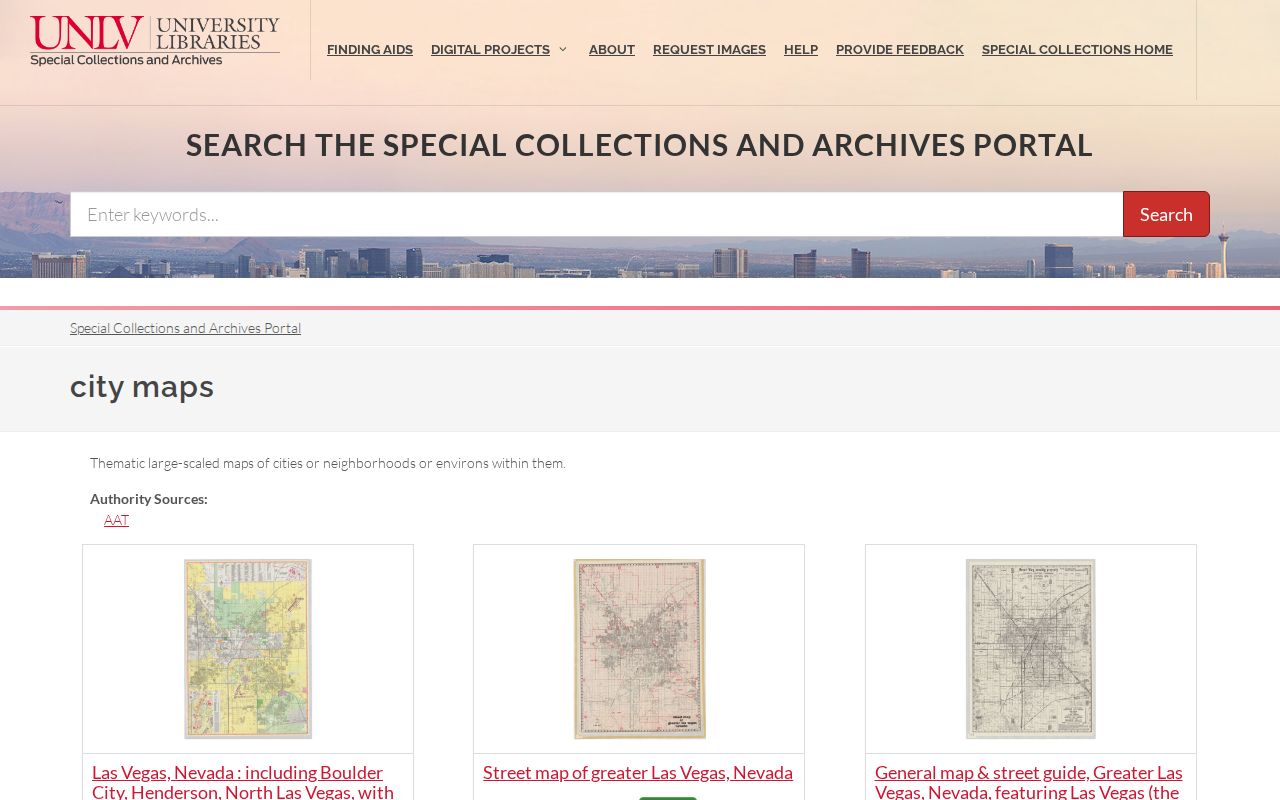
A map can narrow an address question, but it cannot by itself prove who appeared in a city directory entry. Preserve the map date and compare its street index with the printed volume and the parcel's legal description.
Sanborn material is another building-history aid, not a people list. The Library of Congress catalogs a January 1928 Las Vegas atlas of 15 sheets as not available online, and local references also cite 1943 and 1953 maps. Confirm that a sheet reaches the relevant Paradise-era area before using it to date a structure.
Paradise Directory Clues in Newspapers
Newspapers can test whether a directory address belongs to the same person over time. UNLV reports Review-Journal image coverage from March 30, 1929 through December 31, 1996, with full text from September 29, 1996 onward. Las Vegas Sun coverage is scattered and reaches 1996 to the present, while earlier periods rely on citation indexes. The Library District also has a Las Vegas Sun and Review-Journal card index for 1970 through 1982, which is especially useful when a full-text search fails.
The UNLV Nevada newspaper microfilm collection describes the available Review-Journal, Sun, and Nevada newspaper routes for this stage of Paradise city directory research.
Search a surname with the street, a nearby institution, or a subdivision. Obituaries, probate notices, civic meetings, school items, and business notices may supply dated context, but each one needs its own source and date check.
Paradise Directory Research at Libraries
The Library District is a practical first stop for accessible genealogy databases, local history, telephone directories, obituaries, and newspaper resources. Its genealogy page lists HeritageHub, Ancestry Library Edition, HeritageQuest, Chronicling America, Fold3, historical Review-Journal facsimiles, and other collections. Ask staff to check the date, title, and arrangement of a directory rather than requesting a broad "Paradise directory." That precision helps distinguish a phone book, a business supplement, a city directory, and an address-ordered volume.
The Library District genealogy page is the online entry point for those local-history and licensed database channels.
Some databases require a library card or in-building use. If a requested year is not on a public shelf list, library staff, a telephone-directory run, and the newspaper card index are sensible fallbacks before treating the gap as final.
Trace Paradise Directory Households
A household trail works best when every appearance is kept separate by year. Directories can be annual or irregular, while federal census schedules are decade snapshots. Federal census years through 1950 are generally public under the National Archives 72-year release practice. Older census geography may use Las Vegas township or county labels instead of today's Paradise wording, so compare place names with the address and street history rather than rejecting a likely match at once.
- Locate the earliest documented directory, reverse directory, telephone listing, or box reference that fits the name or address.
- Copy the name, street form, and date exactly, then note whether the volume is alphabetical, address ordered, business focused, or mixed.
- Check the next documented year and record any move, changed spelling, or different postal-city label without assuming it is the same household.
- Pair the closest available directory period with the relevant federal census, using the Library District or NARA research channels for census access.
- Use an obituary, probate notice, or newspaper item to test a disappearance, move, or relationship only when the date and identity align.
For an address-first history that continues into recorded land documents, use the Paradise previous residents search after the printed evidence is gathered. A directory can show a printed association with an address, while the deed trail follows parcel and legal-description evidence.
Note: A name disappearing from a local volume can reflect a move, death, changed listing practice, or simply a missing issue, so preserve uncertainty in the timeline.
Paradise Directory Archive Access
UNLV Special Collections and Archives holds important Southern Nevada directories, maps, oral histories, newspapers, student and faculty directories, and local business material. Researchers use the Lied Library reading room on the third floor at 961 E Harmon Ave. First-time registration, call slips, reading-room rules, and an appointment recommendation apply. Official UNLV pages show inconsistent hour blocks, so verify current hours before traveling. The repository's phone is 702-895-2234 and its contact email is special.collections@unlv.edu.
For other routes, the Clark County Museum has archives and a heritage street of homes from the 1910s through the 1970s. The Nevada Historical Society holds photographs, manuscripts, newspapers, maps, and subject files, but its research library is reported closed for renovation from January 2025 through December 2026 with limited staff. The National Archives at Riverside serves Clark County federal records. Each is an access fallback when a directory year cannot be found online.
Paradise Directory Coverage Gaps
Documented dates are strong leads, not a promise of uninterrupted coverage. The record trail includes Nevada Territory reels, Paradise Valley files from 1950 to 1965, Luskey reverse directories in five named years, a Las Vegas volume in 1969, and a 1975 supplement sample. Research did not locate an official catalog proving the first Paradise-specific annual directory, a complete annual Las Vegas run, or a final printed year. Treat an unlisted interval as an access question until a library, UNLV, or museum staff member checks holdings.
The same caution applies to place names. Paradise's legal boundary and Las Vegas postal labels can place the same street history under different headings. Use the directory's abbreviation key, map date, street index, subdivision plat, and later parcel description as an evidence chain. No official source in the research established a Paradise-wide street-renumbering event, so a changed address should be bridged with records rather than guessed.